Recycling and Sustainability — Garden Clearance Canary Wharf
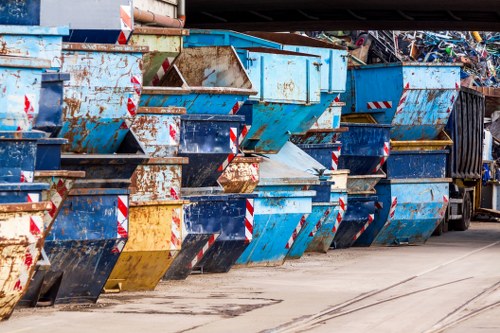
Garden Clearance Canary Wharf is committed to creating an eco-friendly waste disposal area and a truly sustainable rubbish area for both residential and commercial clients across Canary Wharf and the Isle of Dogs. We work to move beyond simple removal: our focus is on material recovery, minimising landfill, and supporting circular-economy solutions for green waste, wood, soil and metals. Every clearance is an opportunity to divert resources.
 Our Canary Wharf garden clearance and green waste removal operations follow clear targets and documented processes. We have set a public recycling percentage target of 75% for all garden materials within the next three years, and an aspirational goal of diverting 90% of organic green waste from landfill through composting and municipal processing. These targets reflect local boroughs' approaches to waste separation and the wider London commitment to reduce biodegradable waste to landfill.
We align our services with the Tower Hamlets and neighbouring boroughs’ recycling schemes—encouraging separation of green waste, food waste, plastics and metals at source. Our garden waste removal in Canary Wharf respects local rules: where borough collections exist we feed into household composting streams; where not, we transport materials to approved transfer stations for processing. This approach ensures that cuttings, turf, hedge trimmings and untreated timber are turned into compost or chipped for reuse rather than burned or buried.
Local Transfer Stations and Sustainable Routes
We use nearby transfer stations and materials recovery facilities (MRFs) such as Bow and Beckton transfer points and partner depots across East London to keep journeys short and to ensure proper sorting. By routing loads through local transfer stations we minimise vehicle miles, improve chain-of-custody for recyclables and increase the proportion of materials recovered. Our documented chain includes on-site segregation, photographic records of loads and regular audits with processing partners to confirm outcome percentages.
Partnerships with Charities and Community Projects
Garden Clearance Canary Wharf actively partners with community groups and registered charities to give usable items a second life. Items that can be reused—such as planters, garden furniture, paving slabs and reclaimed timber—are assessed and, where suitable, donated to local charities, community allotments and urban greening projects. Our partnerships include local community gardens, homelessness charities and reuse-focused charities that accept furniture and materials for refurbishment. These collaborations support a circular approach to garden waste and help local residents benefit from recovered resources.
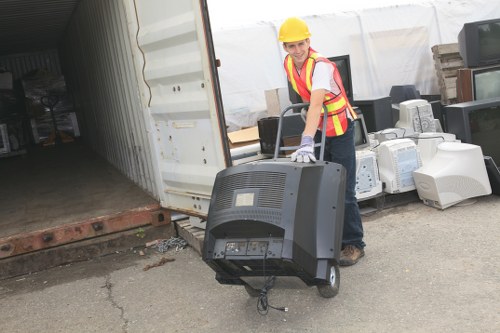
We make clear distinctions between recyclable materials and those suitable for charitable reuse; metals and appliances are routed to appropriate recycling streams, while working timber and functional garden items are prioritised for donation. Our reuse-first policy reduces landfill, supports social enterprises and promotes community resilience in Canary Wharf and surrounding boroughs.
To support a low-carbon rubbish area, our fleet includes low-carbon vans and hybrid vehicles. We invest in electric vans for short urban trips, and modern Euro-6 hybrids for longer or heavier loads. Route optimisation software reduces empty miles and consolidates jobs in proximity to Canary Wharf to keep emissions low. This fleet strategy is part of our broader sustainability plan to reduce operational CO2 emissions per job by at least 40% within five years compared with conventional clearance services.
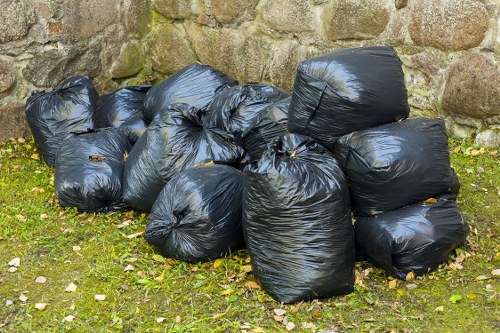 In practical terms, our sustainable rubbish area concept includes on-site segregation stations, secure bins for separated materials and temporary storage designed to protect reusable items. Crews are trained in best-practice separation so that glass, plastics, soil, untreated timber and green waste are isolated at source. We document the destination of each material type and publish aggregated recycling performance so clients can see how their clearance contributed to our recycling percentage target.
We also support borough initiatives such as separate food waste collection pilots and community composting schemes. Light collaboration with local authorities enables co-collection where feasible, integrating our garden clearance operations with municipal systems and ensuring compliant handling of bio-degradable waste streams. This helps create a truly sustainable rubbish area across the local network.
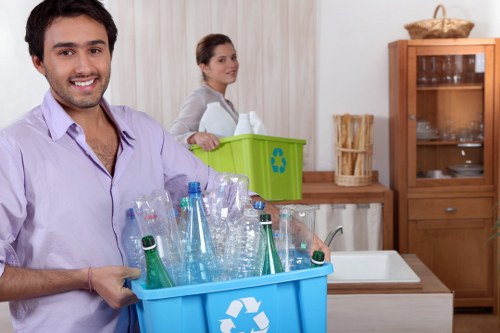
Our commitment to sustainable garden clearance in Canary Wharf extends beyond technical solutions. We embed environmental considerations into pricing, offering clients the choice to prioritise reuse and higher recycling rates. Clear documentation and transparent reporting mean clients know what percentage of their cleared material was recycled, reused or sent for recovery. This accountability supports informed decision-making for businesses, landlords and residents seeking greener waste disposal options.
The combined measures—ambitious recycling percentage targets, strategic use of local transfer stations, charity partnerships to maximise reuse, and a low-carbon van fleet—create a measurable improvement in the local waste landscape. By choosing our Canary Wharf garden clearance services, clients support an urban ecosystem that values resource recovery, reduces landfill dependency and contributes to a sustainable future for the Docklands and nearby boroughs.
We continue to refine processes, seek new partnerships and invest in greener transport and processing routes to keep our sustainable rubbish area best-in-class. Garden waste, bulky items and salvageable materials are treated as assets rather than garbage, and that philosophy is at the heart of every Garden Clearance Canary Wharf job we complete.